


July 1, 2026
The EOFY content audit (what to keep, kill, or rework)Your accountant reviews everything before EOFY, so why does your content get a free pass?
Read More



Small and mid-sized businesses rarely struggle because they lack effort. They struggle because their content has no shape.
There's a blog. A few LinkedIn posts. Maybe a case study buried somewhere on the site. Individually, these pieces are fine. Collectively, they do... not much.
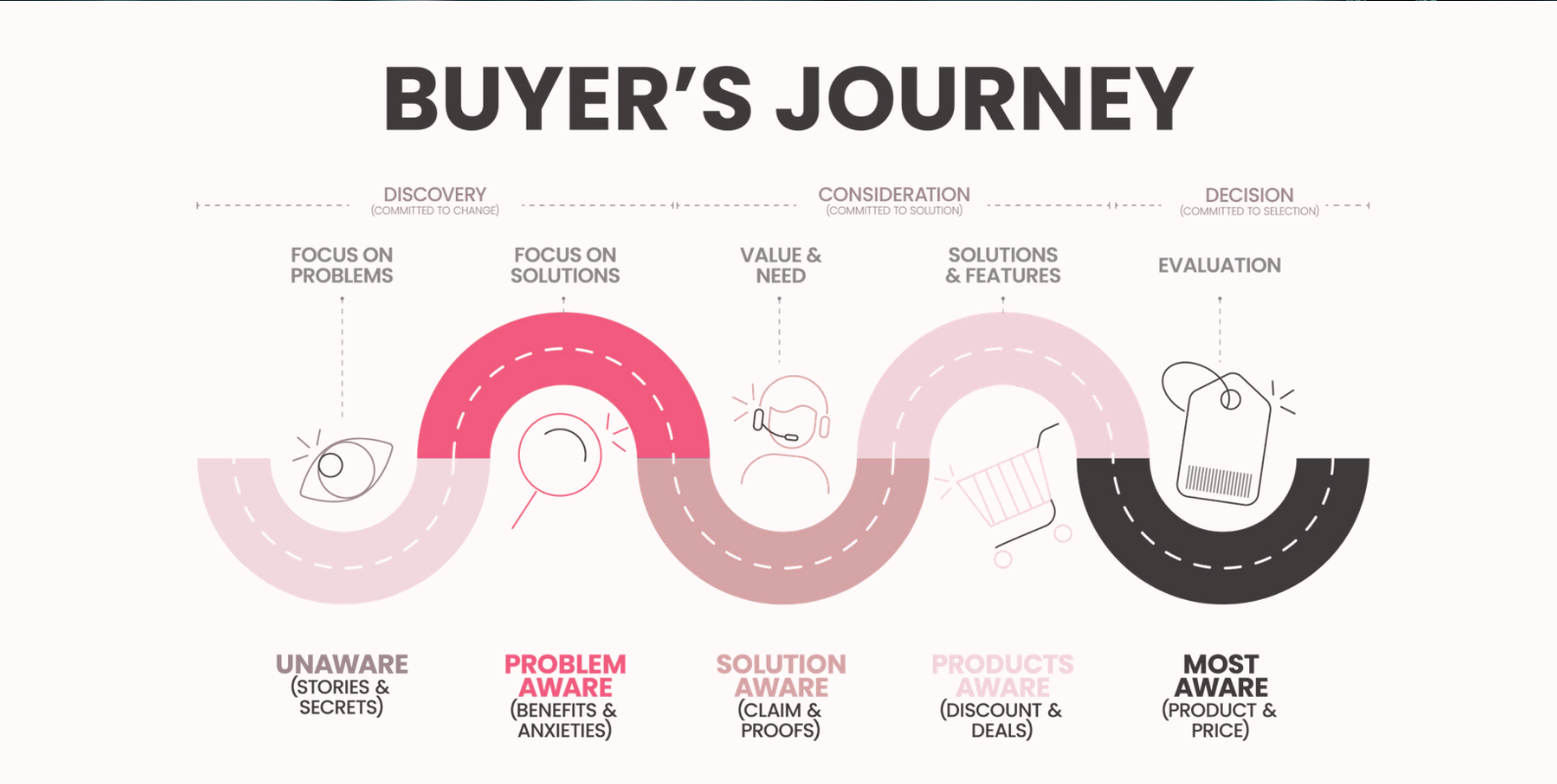
What works isn't more content. It's actually content that matches how buyers move from first awareness through to a decision.
When content's structured around buyer awareness, it stops feeling random. It becomes useful. It starts actually doing something.
Most high-performing SME content ecosystems rely on the same five assets. Not because they're trending (I literally see no one talking about this), but because each one plays a specific role at a specific point in the buying journey.
Buyers don't wake up ready to buy. They move through stages, often slowly.
They start vaguely curious. They become aware of friction. They look for options. They check whether you're actually credible. Then they decide whether it feels safe to take the next step.
Each of the five content pieces below exists to support one of those moments. When one is missing, the whole system feels harder than it needs to be.
This is the content that helps someone understand what they're actually dealing with.
Foundational explainer content answers basic questions clearly and without agenda. It gives people language for their problem and a way to think about it.
This is where trust starts, particularly in complex or regulated industries. I'm speaking to you finance!!
Good foundational content doesn't try to convert. It explains. It clarifies. It becomes the page people are sent when someone says “start here.”
Typical formats include long-form blog posts, evergreen guides, simple education-led webinars, or a clearly signposted resources page.
Examples:
This content is reused constantly. Sales teams reference it. It appears in onboarding. It captures early-stage search demand. And most importantly, it positions your business as someone who understands the space, not just someone trying to sell into it.
This is also the layer many teams skip entirely, which is why we often see businesses needing to rebuild their foundations deliberately through structured work like Capsule Content, rather than adding more disconnected posts.
Once someone has a basic understanding, they start noticing symptoms.
Something feels inefficient... Risky... More painful than it should be.
Problem-aware content speaks directly to that experience. It uses the language people already use internally, not marketing language.
The goal here is recognition. When this content works, readers feel seen. They recognise their situation without being told what to buy.
This content often takes the form of:
Examples:
This content performs best mid-funnel. It drives engagement, list growth, and meaningful conversations because it names the problem clearly without rushing to the solution.
When teams recognise themselves here, the issue is rarely effort. It's usually visibility into what is actually happening. This is exactly the point where a Blog Audit gives clarity, before any decisions about writing more content are made.
At this point, buyers know they need to fix something. They're trying to understand what “better” looks like.
Solution-focused content, again, doesn't push a product. It explains approaches, trade-offs, and outcomes.
This is where comparisons, frameworks, and clear explanations matter. Buyers want to know how different options work, what changes operationally, and what results are realistic.
Common formats include:
Examples:
This content often links directly from problem-aware pieces and naturally leads to demos, trials, or diagnostic calls. It helps buyers evaluate without pressure.
This is also where content stops being a collection of posts and starts behaving like a system. For many teams, this kind of structure is what sits underneath a longer-term approach like the Visibility Package, where content starts being created for a purpose.
Even when a buyer understands the problem and the solution, they still want reassurance.
They want to know whether this works for businesses like theirs.
Credibility content answers that question.
Strong proof content focuses on specifics. What changed. What improved. What was reduced. Time, risk, effort, cost.
Formats that work well include:
Examples:
Placement really matters here. This content belongs on home pages, pricing pages, proposals, and late-stage nurture emails. It is not about persuasion, but reassurance.
At a more mature level, this kind of credibility often extends beyond individual case studies into visible authority, where leaders and teams are known for how they think. That is the role Executive Thought Leadership plays when proof and perspective need to compound together.
The final piece is often the weakest for SMEs, even though it directly affects revenue. Interesting how that works.
Next-step content explains how to engage. Clearly, calmly, and without drama.
It answers practical questions:
This usually lives on service pages, booking pages, or “work with us” sections. When done well, it removes uncertainty and makes taking action feel straightforward.
Examples:
This content works best when it is linked naturally from earlier pieces, not introduced abruptly. For many teams, the most useful next step here is not a rewrite, but clarity on what to fix first through something like The Website Audit or a contained 1:1 Strategy Session to sense-check direction.
Most SMEs do not need all five pieces immediately, but they do need to start in the right place.
The first priority is building a proper foundation. For most teams, that looks like a core group of foundational articles that cover the essential questions buyers ask before they ever consider vendors.
Once that foundation exists, problem-aware content becomes far more effective, because it has somewhere to lead people back to. From there, next-step content can do its job without feeling abrupt or sales-led.
In other words, foundations first. Then friction. Then action.
Final thing: Content doesn't fail because SMEs are bad at it. It fails because it's built without a system.
These five pieces aren't a checklist. They're a map. When each one is doing its job, content becomes easier to create, easier to maintain, and far more effective.
If you’re unsure which of these pieces you’re missing or where to start, the most useful next step is usually a short conversation.
The 1:1 Strategy Session exists for exactly that. Clarity first. Decisions after.
No, and trying to build everything at once is one of the most common mistakes SMEs make. Start with foundational explainer content first. Once that's in place, the other pieces have something to connect to, and the whole system becomes more effective.
Not necessarily. A blog is a format, not a system. What makes content work is whether each piece serves a specific role in the buyer journey — awareness, recognition, evaluation, reassurance, and action. If your posts aren't structured around those stages, they may be generating traffic without generating business.
Most content advice focuses on volume or SEO — publish more, rank higher. This framework focuses on function. Each piece exists to move a buyer from one stage of awareness to the next. It's less about output and more about whether your content is actually doing a job.
Two tend to be the weakest: foundational content (which is often skipped entirely) and next-step content (which is often vague or buried). Ironically, these are the pieces that most directly affect whether buyers ever start engaging, or actually convert.
How do I know which piece I'm missing? The fastest way is to map your existing content against the five stages and look for gaps. If you're not sure where to start, a short content or website audit can give you a clear picture before you invest in creating anything new.
July 1, 2026
The EOFY content audit (what to keep, kill, or rework)Your accountant reviews everything before EOFY, so why does your content get a free pass?
June 15, 2026
Justifying your content marketing budget when leadership wants to cutContent is the easiest budget to cut and the hardest to defend, so here's how to justify the spend when the people upstairs are counting every dollar.
May 18, 2026
How to plan your B2B content for FY26-27 before 1 JulyThe June checklist for B2B marketing leaders who want to start FY26-27 with a real plan, not a blank page.
.png)
.png)