
Most businesses have more than one audience. Actually, I'd go further than that. In nearly a decade of working with businesses across finance, fintech and tech, I can count on one hand the number of companies I've spoken to that genuinely only have one.
And yet, the vast majority of those businesses are trying to speak to all of their audiences at once.
One homepage. One set of messaging. One blog strategy. One newsletter. All of it aimed at "everyone." Which, in practice, means it's aimed at no one.
I get why it happens. When you're building a business, you're stretched. You don't have the time, budget or headcount to create five versions of everything. So you try to find the middle ground. You write copy that's broad enough to cover all your bases. You publish content that touches on a bit of everything. You tell yourself that anyone who lands on your site will be able to figure out where they fit.
But they won't. And they don't.
This guide is going to walk you through why speaking to multiple audiences at once is undermining your content, what the businesses doing it well actually look like, and how you can start structuring your own content to reach the right people with the right message. Whether that's on your website, your blog, LinkedIn, email or all of the above.
Fair warning, it's long. And deliberately so. This isn't a surface-level overview. It's everything I know about multi-audience content strategy, laid out in a way that you can actually use.
Section 01
Here's the thing about generic messaging. It feels safe. It feels like the responsible choice because you're not excluding anyone. But the reality is actually the opposite.
When your content tries to speak to everyone, it does a few things badly.
It fails to connect.
People respond to specificity. They want to land on your website and immediately see themselves reflected. Their role, their challenges, and their language. When your copy is vague enough to apply to any reader, no reader feels like it was written for them. And when no one feels like it was written for them, no one acts on it.
It weakens your value proposition.
If you sell a product or service that helps both CFOs and marketing managers, those two people have fundamentally different problems. A CFO cares about risk, compliance, cost efficiency. A marketing manager cares about speed, approvals, getting content out the door. If your messaging tries to address both at the same time, it'll water down the value for each. You end up listing features rather than solving problems.
It makes your content strategy directionless.
Without clear audience segments, you can't build a meaningful content plan. You end up publishing whatever feels relevant that week, rather than building topical authority for each audience over time. This results in a blog that looks like a patchwork quilt of disconnected topics, and a content library that doesn't serve anyone particularly well.
It costs you conversions.
The data backs this up.
7x
more leads from targeted landing pages
7x
more revenue from segmented email
2x
conversion from personalised CTAs
When you speak to someone specifically, they're more likely to take the next step. When you don't, they bounce. The irony is that most businesses know this intuitively. They'll nod along when you talk about the importance of knowing your audience. But the gap between knowing it and doing it is enormous.
Section 02
Before we get into the how, let's look at a few businesses that have figured this out. These are companies with genuinely different audiences, and they've structured their content to serve each one properly.
Employment Hero is an Australian HR, payroll and hiring platform that serves four distinct audiences: businesses, partners, employees and job seekers. Those four groups have wildly different needs, and Employment Hero's website reflects that from the moment you land on it.
.png)

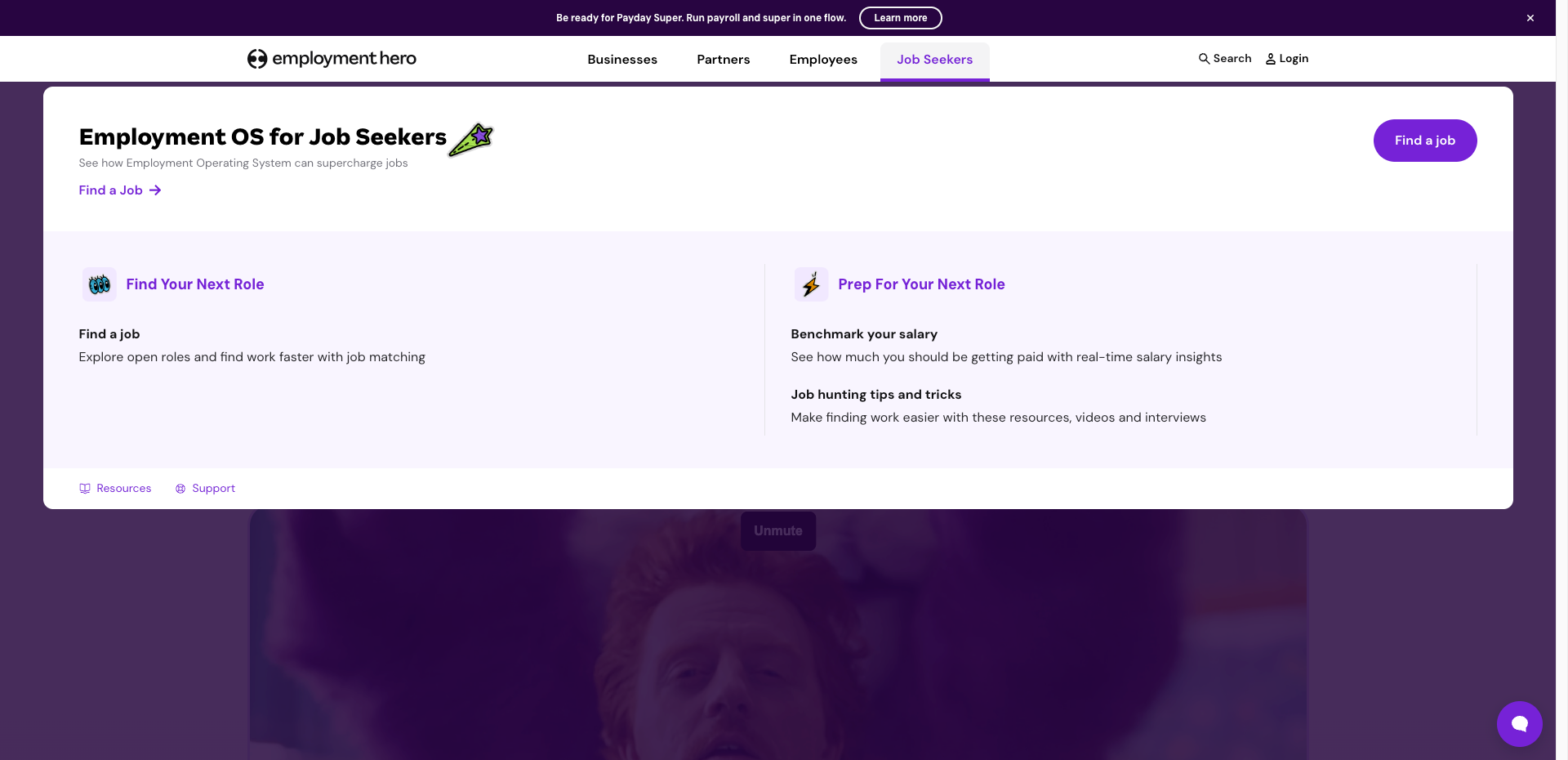

Their top-level navigation is split by audience. You choose who you are, and the site reshapes around you. Businesses see products, pricing and integrations. Partners see the partner network, referral programmes and certification pathways. Employees see the app, their benefits and learning tools. Job seekers see job listings and career resources.
Each audience gets its own ecosystem of pages, content and calls to action. Nothing is shared for the sake of convenience.
This is audience-first architecture at its best. The navigation does the segmentation work for you. When someone arrives, they immediately see themselves, and they know exactly where to go.
It's worth noting that this level of separation requires a lot of investment. You need dedicated pages, dedicated copy and an information architecture that supports it. But the payoff is a site that converts because every visitor gets a tailored experience.
Microsoft's approach to multi-audience content on LinkedIn is one of the best examples of how to use the platform's features strategically. It actually came up in a recent conversation in a B2B marketing group I'm part of, about who's using showcase pages well. It's the strongest use case I'm seeing at the moment.
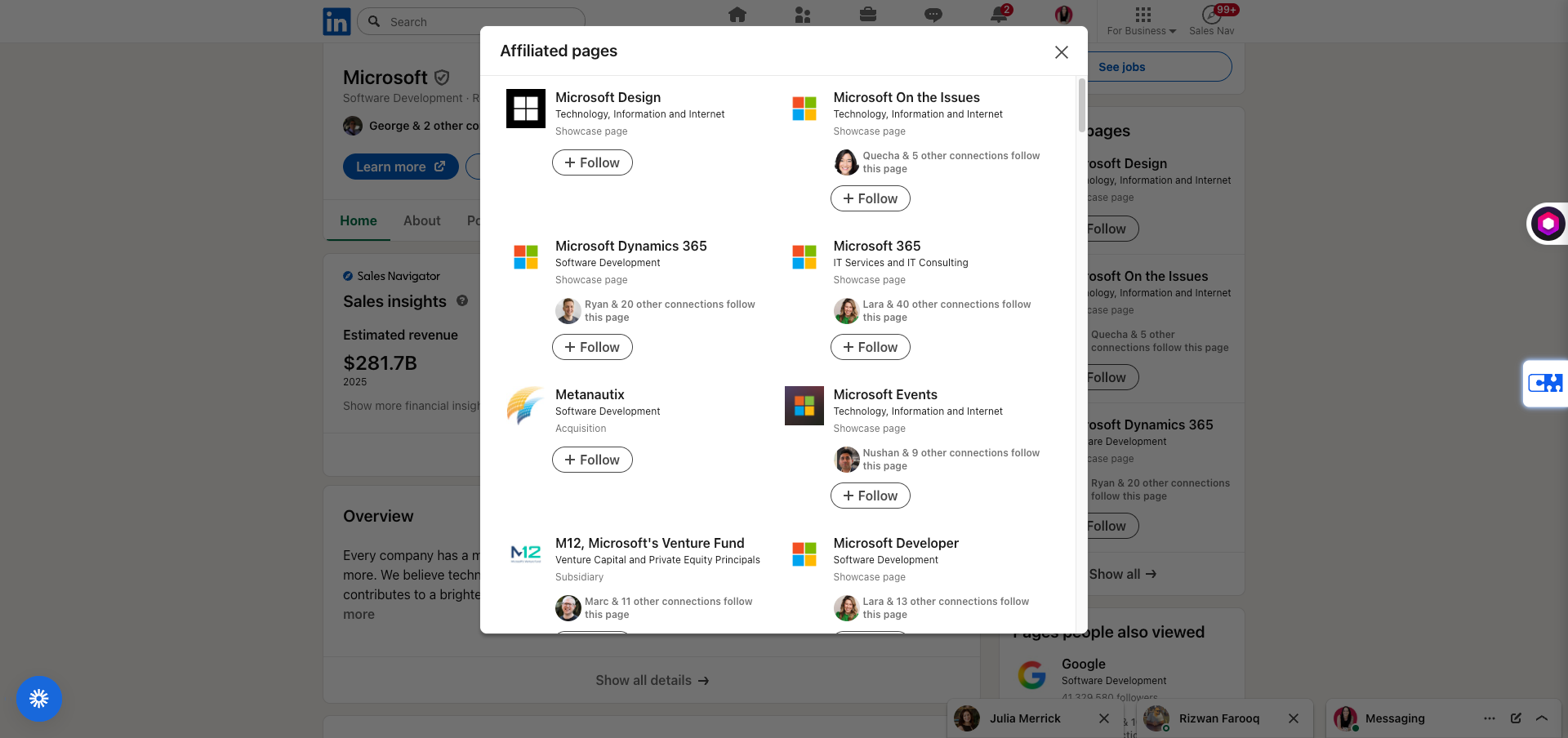
But then they've built out more than a dozen showcase pages, each dedicated to a specific product or audience. Microsoft 365, Microsoft for Healthcare, Microsoft Advertising, Microsoft for Nonprofits, and more. Each showcase page has its own content strategy, its own posting cadence and its own follower base.
This means someone in healthcare gets deeply relevant content about clinical workflows and patient data without being bombarded with advertising platform updates. A nonprofit sees content about grant management and social impact without wading through enterprise product messaging.
The key insight here is that Microsoft's company page doesn't try to do everything. It serves as the brand hub, and the showcase pages do the audience-specific heavy lifting.
LinkedIn's showcase pages are massively underused by mid-market and growing businesses. If you have more than one audience and the resources to manage the pages, they're worth serious consideration.
Haast is a compliance software company that helps legal, compliance and marketing teams manage content approvals. The product is fundamentally the same regardless of who's using it, but the value proposition changes significantly depending on the audience.
This is actually a great example of what multi-audience content looks like at a smaller scale, without the resources of a Microsoft or an Employment Hero.

What Haast does well is create dedicated pages for each audience. Their site has separate sections for compliance teams and marketing teams, plus industry-specific pages for sectors like telecommunications and financial services. Each page speaks directly to the problems that audience faces, in their language, with their priorities front and centre.
For compliance teams, the messaging focuses on reducing review time, codifying risk tolerance and maintaining audit trails. For marketing teams, it's about getting content approved faster, reducing iterations and eliminating messy email-based approval workflows. It’s the same product, but a completely different angle.


They also produce bespoke content for each audience. Their marketing compliance report (written by yours truly) is written squarely for marketing leaders, while their legal buying ops guide targets the legal and compliance side. This is what audience-specific content strategy looks like in practice.
Each piece is built for a specific reader, not a generic "user." This is what audience-specific content strategy looks like in practice. You're not just segmenting your site. You're segmenting your entire content output.
Xero is another strong example, and one that's particularly relevant for financial services. Their cloud accounting software serves two primary audiences: small business owners and accountants or bookkeepers.


Those two groups use the product differently, buy it differently and care about different things entirely. A small business owner wants simplicity, automation and visibility over their cash flow. An accountant wants practice management tools, client collaboration and compliance features.
Xero's website reflects this cleanly. Small businesses get the consumer-facing experience: plans, pricing, product features, and resources about managing their finances. Accountants and bookkeepers get a partner programme, practice tools, and resources about growing and managing their practice. The navigation, content and calls to action are all tailored.
Their content marketing follows the same principle. Blog posts, guides and webinars are segmented by audience. Resources for small businesses sit separately from resources for accounting professionals. The brand is consistent, but the message adapts.
Section 03
Now that you've seen what good looks like, here's how to do it yourself. This isn't a quick fix. But it is the foundational work that shapes everything else your content does.
01
Segment your audiences
02
Audit what you've got
03
Structure your website
04
Create bespoke content
05
Rethink LinkedIn
06
Segment your email
This sounds obvious, but most businesses haven't done this with enough rigour. Having a vague sense that "we sell to CFOs and also to ops managers" isn't segmentation. It's a good starting point though.
For each audience, you need to define:
Who they are. Job title, seniority, industry, company size. Be as specific as you can. "Financial decision-makers" is too broad. "CFOs at mid-market financial services firms with 50 to 200 employees" gives you a lot more to work with.
What they care about. What keeps them up at night? What are they trying to achieve? What does success look like for them? This needs to go deeper than surface-level pain points. You need to understand the underlying motivations.
How they talk about their problems. This is critical for content. A compliance officer talks about risk mitigation, regulatory exposure and defensibility. A marketing manager at the same company talks about approval bottlenecks, turnaround times and creative freedom. If your content doesn't use their language, it won't land.
Where they consume content. Some audiences live on LinkedIn. Some rely on industry newsletters. Some search Google for specific problems. Your distribution strategy should match their habits, not yours.
What role they play in the buying decision. Are they the end user, the decision-maker, the budget holder or the influencer? Each role needs different content at different stages of the journey.
This is the foundational work that everything else builds on, and not just content. If your audience profiles are thin, everything downstream will be too. A proper content strategy starts from here, with audience segmentation that's specific enough to actually inform what you create and where you publish it.
Before you start creating new content, look at what exists. Most businesses have a library of content that's been published without a clear audience lens. Blog posts that try to serve everyone. Web pages that blend messaging for different segments. Emails that go out to the entire database.
A content audit through an audience lens will show you where the gaps are. Go through your existing content and tag each piece by the audience it's actually serving. You'll likely find that most of it skews toward one audience, or worse, that most of it doesn't clearly serve any audience at all.
This is also a good time to look at your website structure. Map out your current site architecture and ask yourself: if a [specific audience member] landed on this site right now, how quickly could they find content that speaks directly to them? If the answer is "they'd have to dig," that's a problem.
A blog audit works the same way. Are your articles building topical depth for each audience, or are they scattered across topics without a clear thread? Strong content strategy builds authority over time. If you're publishing for three audiences but only creating one or two pieces per audience per quarter, you're not building enough depth for any of them.
This is where the examples above become a practical blueprint. How you structure your site depends on the size and complexity of your business, but the principle is the same: make it easy for each audience to find themselves.
For smaller businesses or those with two to three audiences, audience-focused landing pages are the starting point. These are dedicated pages that speak to each audience individually. They address that audience's specific problems, explain how your product or service solves them, and include relevant case studies or proof points. Think of them as tailored entry points.
These landing pages should be accessible from your top-level navigation. If someone has to click through three layers to find the page that speaks to them, they won't. Put your audiences in the nav. Make it obvious.
For larger businesses or those with highly distinct audiences, you might need full audience subsections, like Employment Hero's approach. This means each audience gets their own section of the site with dedicated pages for features, use cases, resources and proof points. The investment is bigger, but the payoff is a site that genuinely serves each audience rather than hoping they self-select from a generic homepage.
Either way, the homepage needs to do one thing above all else: help people identify which audience they belong to and guide them to the right place. If your homepage tries to explain everything to everyone, it explains nothing to anyone.
This is where most businesses get stuck. They understand the theory but baulk at the practicality of creating separate content streams for each audience.
The truth is you can't just copy the same blog post and swap out a few words. Each audience needs content that's genuinely written for them. That means different topics, different angles, different examples and often different formats.
For a compliance software company, an article about regulatory changes in US financial services is a very different piece from an article about how marketing teams can speed up their approval workflows. The product connection might be the same, but the content serves completely different people.
This is where building individual content strategies for each audience becomes essential. Each audience needs its own editorial calendar, its own topic clusters and its own content goals.
There will be overlap, and that's fine. Some topics are relevant to multiple audiences. But even when the topic overlaps, the angle should differ. A piece about "how AI is changing compliance" aimed at legal teams will read very differently from the same topic aimed at marketing teams. Same subject. Different framing, different depth, and different takeaway.
Building topical authority for each audience is a long game, but it's how you become the go-to resource for each segment. When you publish consistently for a specific audience on a specific set of topics, you build trust and recognition over time. Scattered content doesn't do that. Focused, audience-specific content does.
This is actually one of the different use cases for Capsule Content, if you want to dig into how that works.
Most companies use LinkedIn the same way they use their homepage: one feed, one message, one audience. And just like the homepage problem, it doesn't work.
There are a few ways to approach multi-audience content on LinkedIn, depending on your size and resources.
Option one: use key stakeholders as audience-specific voices.
This is particularly effective for smaller and mid-market businesses. Instead of trying to make the company page serve every audience, use the personal brands of your leadership team. Your CEO might speak to investors and strategic partners. Your Head of Product might speak to technical buyers. Your Head of Customer Success might speak to existing customers and end users.
Each person becomes the face of a specific audience conversation. The company page can then serve as the broader brand presence, covering announcements, culture and company-level content, without trying to be everything to everyone.
Building these personal brands takes time and consistency, but the return is significant. People engage with people, especially on LinkedIn. A CTO sharing their genuine perspective on a technical problem will always outperform a company page posting the same insight as branded content.
Option two: use LinkedIn showcase pages.
This is the Microsoft approach, and it works well for businesses with distinct product lines, service areas or market segments. Each showcase page has its own follower base, its own content strategy and its own analytics. Followers can subscribe to the showcase page that's relevant to them without needing to follow the main company page.
The challenge here is resourcing. Each showcase page needs regular, high-quality content to be worth maintaining. If you create three showcase pages and post to each one sporadically, you're worse off than having one strong company page. Only go down this path if you can commit to consistent content for each.
This should probably be higher, but here we are. If there's one channel where audience segmentation is absolutely critical, it's email. And yet it's the channel where I see businesses making the biggest mistakes.
Sending the same newsletter to your entire database is not a strategy, it's a broadcast. And it's one of the fastest ways to train your audience to ignore you.
Different audiences care about different things. A newsletter that opens with a deep dive into regulatory compliance is going to lose every marketing manager on your list before they hit the second paragraph. And vice versa.
Segment your lists by audience from day one. If you're collecting email subscribers, give them a way to self-identify. Which audience are they? What topics are they interested in? Use that data to send targeted, relevant content.
At minimum, you should be able to segment by role or audience type. Ideally, you're also segmenting by engagement level, stage in the buyer journey and topic interest.
The payoff is huge here. Segmented campaigns consistently outperform unsegmented ones in open rates, click-through rates and conversions. When someone opens an email and the content is directly relevant to them, they read it. When it's not, they unsubscribe. It really is that straight forward.
Section 04
I know this is a lot. And if you're a business that's currently running one website, one blog and one newsletter for all your audiences, the idea of segmenting everything can feel paralysing.
So here's my advice: don't try to do it all at once.
The businesses that do this well didn't get there overnight. They built it over time, making deliberate decisions about who they're talking to and how. And the ones that are still trying to talk to everyone at once? They're the ones reaching out to people like me, wondering why their content isn't converting.
Section 05
Full transparency: this is what I do. I work with businesses across financial services, fintech and tech to build and execute content strategies that actually serve their audiences rather than trying to serve everyone at once.
That ranges from the foundational strategy work (audience segmentation, content audits, editorial planning) through to execution: website copy, blogs, thought leadership, LinkedIn content and email. Some clients need the whole picture. Some need help with one piece of it.
If any of this feels relatable and you want to talk about how it applies to your business, I'm always up for a conversation. You can book a call directly in my calendar here.
Book a call and tell me who you're trying to reach. You'll walk away with at least one thing to fix, even if we never work together.